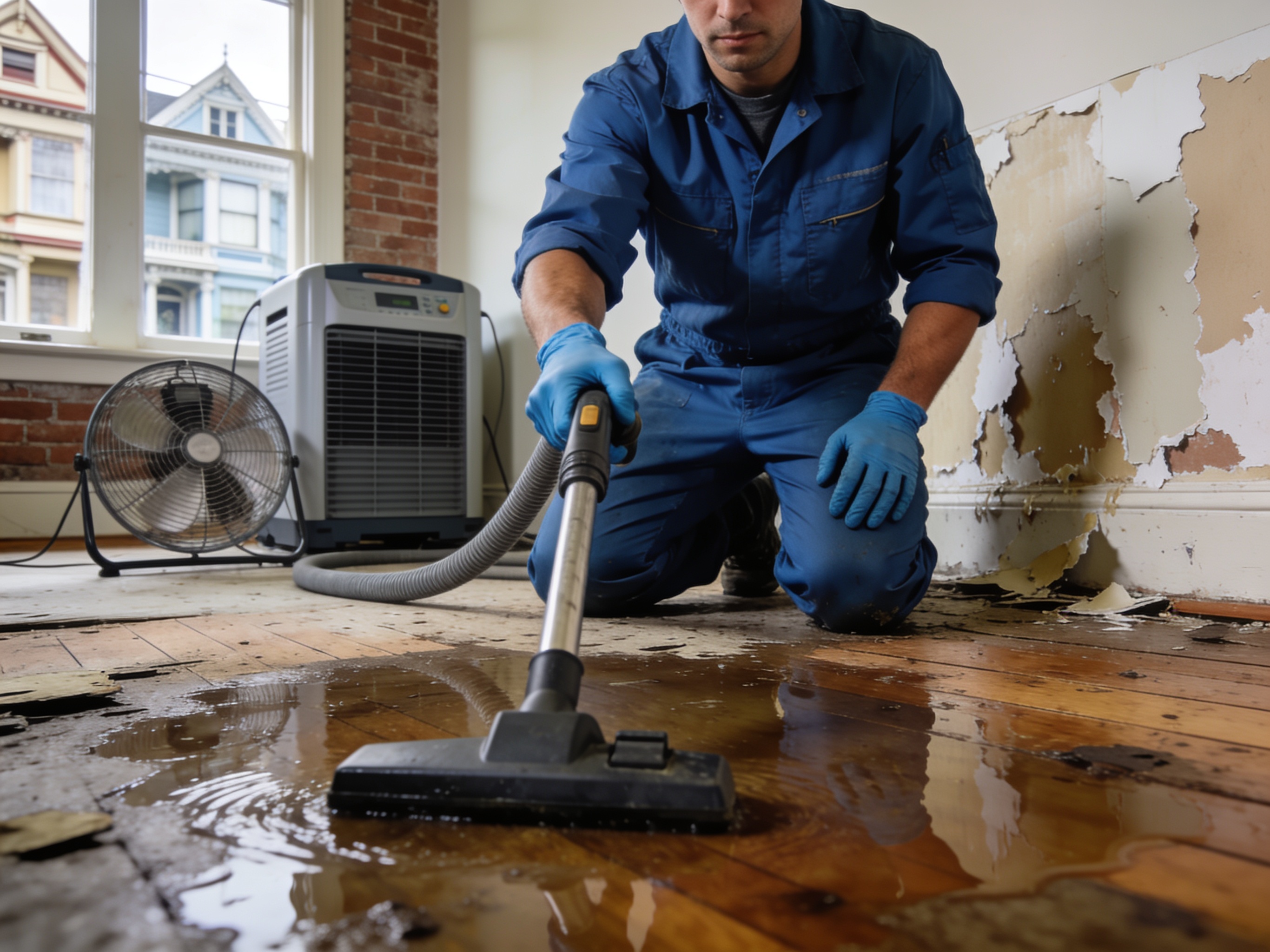
San Francisco's wet winters bring repeated rain that finds its way into older housing stock built on hills. Homes in Pacific Heights, Nob Hill, and Russian Hill often have original plumbing and flat roofs that channel water into walls and ceilings when drains clog. Crews must account for the dense, multi-story construction where moisture travels vertically between units faster than in newer single-family builds.
The mild Mediterranean climate means summers stay cool but do not dry out hidden moisture quickly. In the Sunset District and Richmond District, fog keeps relative humidity high, so extraction and dehumidification must run longer to prevent secondary mold growth behind lath-and-plaster walls common in pre-1940 buildings. Work near the Financial District or Transamerica Pyramid area adds traffic and access constraints that extend response times.
Nearby cities such as Oakland, Berkeley, and Daly City share similar soil and slope issues, but San Francisco jobs frequently involve shared walls and historic districts that limit equipment placement. Technicians check for hidden pockets in basements and crawl spaces where bay-area clay holds water against foundations for weeks after storms.
Every job starts with moisture mapping using meters calibrated for local wood species and plaster. Containment barriers protect adjacent rooms while negative air machines run to capture particulates stirred up during demolition of saturated drywall.
Technician insight
In San Francisco, the thing that catches most people out with water damage restoration is how the steep grades in Russian Hill and Pacific Heights send winter runoff straight into older basements that lack modern French drains, turning a small roof leak into wall saturation across two floors before anyone notices.
Castro District ceiling leak after December rains
Water migrated from a flat roof through plaster into the top-floor unit and down to the unit below. Mapping showed hidden moisture behind shared walls. Extraction and drying equipment ran for five days with daily checks, followed by selective plaster replacement to match the original texture.
Water Damage Restoration Service Services We Offer
✓Emergency Water Extraction
Rapid removal of standing water from basements and ground floors in neighborhoods like the Mission District and Marina District before it migrates to neighboring units.
✓Structural Drying After Leaks
Targeted drying of walls, floors, and ceilings in older San Francisco homes where plaster and lathe hold moisture longer than modern drywall.
✓Ceiling and Wall Restoration From Roof Leaks
Repair and drying of water intrusion through flat roofs common in the Sunset District and Richmond District during winter rains.
✓Crawl Space and Basement Moisture Control
Extraction and ventilation work in hillside properties in Russian Hill and Pacific Heights where slope directs runoff toward foundations.
✓Content Drying and Pack-Out
Safe removal and drying of furnishings and belongings from multi-unit buildings in the Castro and Haight-Ashbury to prevent cross-contamination.
✓Post-Flood Cleanup in Commercial Spaces
Water removal and drying for ground-floor retail and offices near the Financial District and Chinatown where foot traffic and shared utilities complicate access.
Water Damage Restoration Service Cost in San Francisco, CA
| Service | Typical Range | What Affects It |
|---|---|---|
| Initial inspection and moisture mapping | $150–$350 | Higher in multi-story buildings with limited parking |
| Emergency water extraction | $400–$1,200 | Varies with depth and whether pumps must be staged on hills |
| Structural drying package | $800–$2,500 | Longer run times in foggy Sunset and Richmond neighborhoods |
| Content pack-out and drying | $600–$1,800 | Depends on volume and need for climate-controlled storage |
| Final clearance testing | $200–$450 | Required when insurance or property management requests documentation |
Ranges are typical for San Francisco, CA and confirmed with an exact written quote before any work starts.
How it works
- 1
Arrival And Assessment
Technician arrives from the Brannan Street location, documents visible water, and uses moisture meters to trace migration through San Francisco's older framing.
- 2
Water Removal
Pumps and extractors pull standing water while containing runoff to avoid affecting lower levels in dense buildings.
- 3
Drying And Monitoring
Air movers and dehumidifiers run with daily readings until materials reach local equilibrium moisture content.
- 4
Sanitation And Repair
Affected surfaces are treated, then drywall or plaster is replaced to match existing finishes.
- 5
Final Verification
Post-drying inspection confirms no elevated moisture remains before handing the space back to the owner.
Pricing
Pricing depends on water volume, affected square footage, and building access; call for an upfront assessment during business hours.