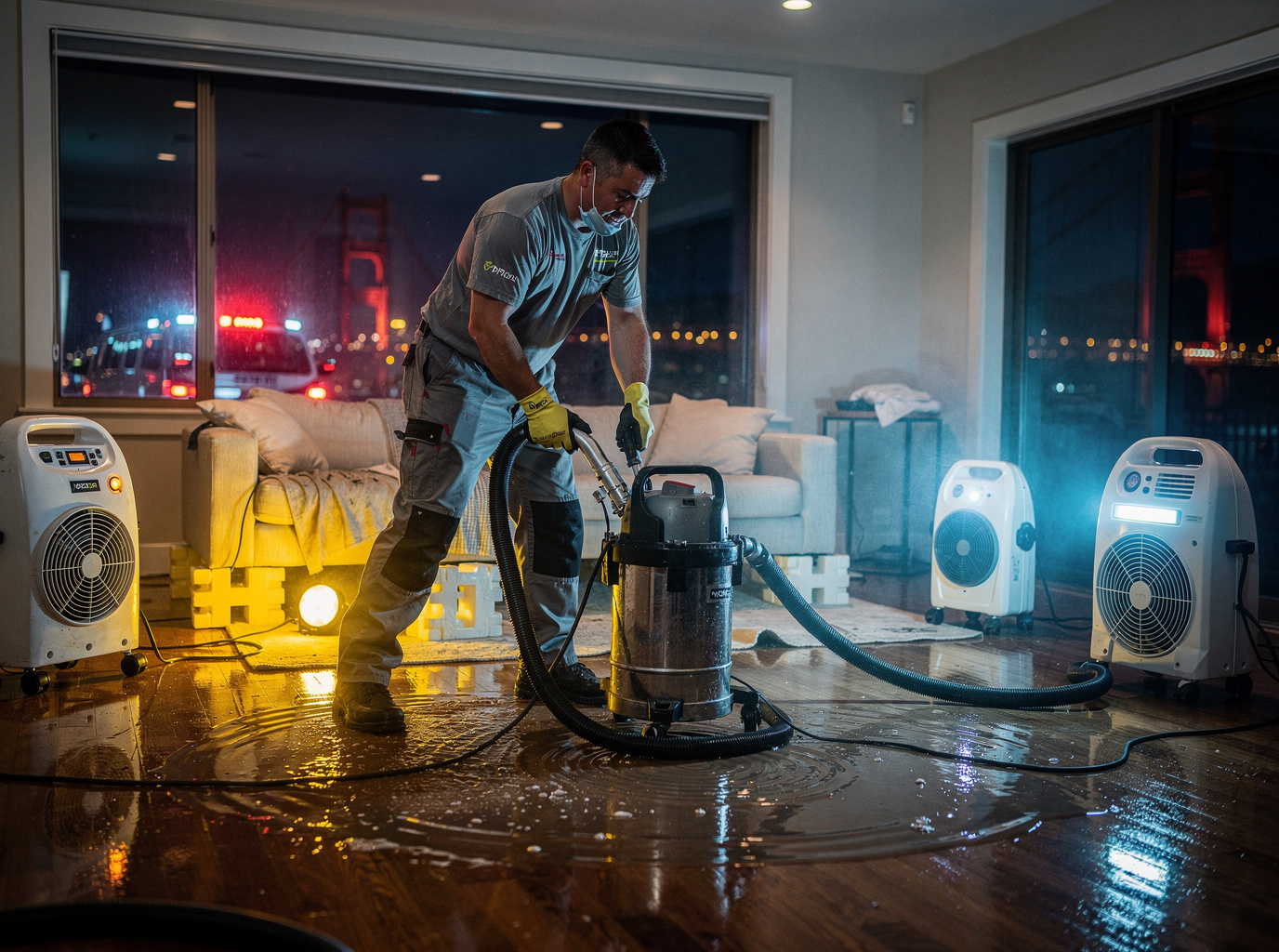
San Francisco's wet winters often send water through aging galvanized pipes and flat roofs common in Victorian and Edwardian stock from the Mission District to Pacific Heights. Once moisture reaches lath-and-plaster walls or balloon-framed floors, hidden pockets form quickly behind baseboards and under hardwood. Technicians must map these paths with moisture meters because standard drywall methods fail against the dense redwood framing found in many pre-1940 buildings.
Cool, humid summers slow natural evaporation, so extraction equipment must run longer in the Sunset and Richmond Districts where fog keeps relative humidity elevated. Sewage backups from combined storm and sanitary lines are frequent near the Financial District and North Beach after heavy rain. Containment and negative air setups are required to keep affected units from cross-contaminating adjacent apartments in these dense blocks.
Terrain matters on the steep grades of Russian Hill and Nob Hill. Gravity-fed drainage can push water into lower-level units or garages, requiring pumps staged at multiple elevations. In Chinatown and North Beach, narrow alleys limit equipment access, so crews often carry portable extractors up multiple flights rather than relying on truck-mounted units.
Technician insight
In San Francisco the thing that catches most people out with Emergency Water Damage Restoration is how quickly water travels downward through balloon framing on the steep blocks of Russian Hill and Pacific Heights. A leak on the third floor can saturate plaster two stories below before anyone notices, and the dense redwood joists hold moisture far longer than newer pine.
Castro Victorian Lower-Level Saturation
Water from a second-floor laundry line seeped through floorboards into the unit below during a January storm. Meters showed elevated readings in the subfloor and base of the original lath walls. Crews extracted water, placed drying equipment across both units, and returned daily until readings stabilized without removing any finished surfaces.
Emergency Water Damage Restoration Services We Offer
✓Burst Pipe Water Extraction
Immediate removal of standing water from galvanized or copper line failures common in pre-war homes across the Mission District and Castro.
✓Storm and Rainwater Cleanup
Extraction and drying after roof or window leaks during the wet winter months that affect Sunset District and Richmond District properties.
✓Sewage Backup Remediation
Safe removal and disinfection of contaminated water from combined sewer overflows that back up into lower levels near the Financial District and North Beach.
✓Hidden Moisture Mapping
Thermal and meter-based detection of trapped water behind plaster and under hardwood floors typical in Haight-Ashbury and Pacific Heights Victorians.
✓Multi-Unit Containment
Negative air and barrier setups to prevent moisture and odor migration between units in dense buildings found in Chinatown and Nob Hill.
Emergency Water Damage Restoration Cost in San Francisco, CA
| Service | Typical Range | What Affects It |
|---|---|---|
| Emergency Extraction Visit | $350–$750 | Base fee covers first two hours; additional time required for multi-story access in Nob Hill or Russian Hill properties. |
| Full Drying Package | $1,200–$3,500 | Covers equipment for typical Mission District flat; higher when fog delays drying in the Sunset District. |
| Sewage Containment Add-On | $800–$1,800 | Includes barriers and negative air for adjacent units in Chinatown or North Beach buildings. |
Ranges are typical for San Francisco, CA and confirmed with an exact written quote before any work starts.
How it works
- 1
On-Site Assessment
Technicians arrive from the 838 Brannan St base, inspect affected rooms, and document moisture levels in walls, floors, and ceilings.
- 2
Water Removal
Portable and truck-mounted pumps extract standing water while protecting adjacent units common in San Francisco multi-family buildings.
- 3
Drying And Monitoring
Air movers and dehumidifiers run until readings drop below 15 percent moisture content, with daily checks in older wood-framed structures.
- 4
Final Clearance
Final meter verification and removal of equipment once all materials are dry and safe for reconstruction.
Pricing
Upfront written estimates provided after inspection; final cost depends on water volume, number of affected levels, and access constraints in older buildings.