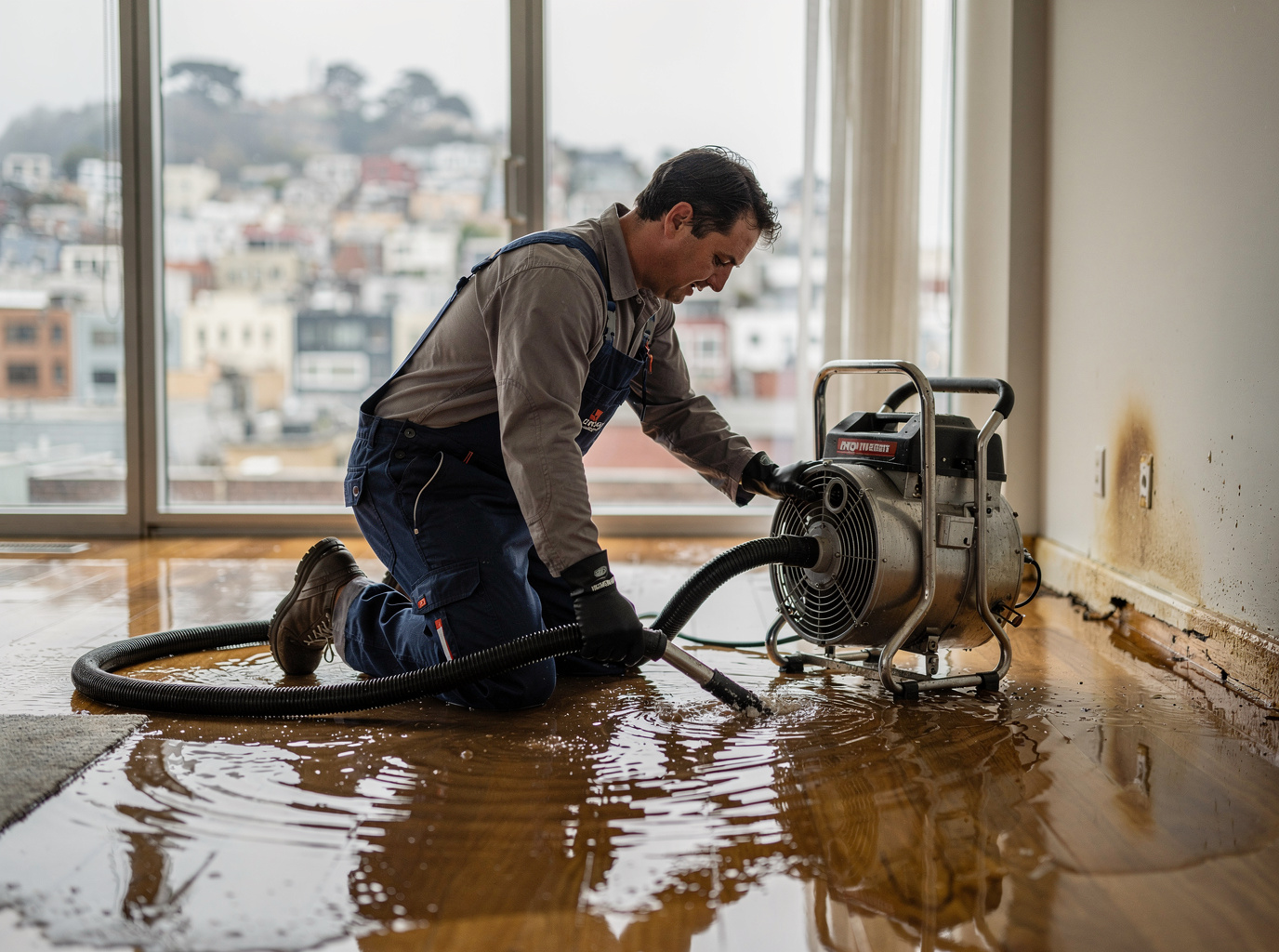
San Francisco's mild Mediterranean winters bring steady rain that finds every weak point in the city's older housing stock. Pre-1906 buildings in neighborhoods like the Mission District and Nob Hill often feature lathe-and-plaster walls and raised foundations that trap moisture against redwood sills. When water enters through roof valleys or cracked cast-iron pipes, it travels laterally along floor joists and into adjacent units faster than in newer construction.
Cleanup crews must account for the tight setbacks and steep grades common in Russian Hill and Pacific Heights. Pumping equipment has to be staged on narrow streets while avoiding cable car tracks and historic facades. After extraction, dehumidifiers run longer because the cool, foggy summers slow evaporation; leaving hidden moisture in subfloor cavities leads to dry rot that spreads to neighboring properties in attached Victorians.
Disposal rules in San Francisco require separating saturated drywall and insulation from regular construction debris, especially when Category 3 water from backups reaches the Financial District or Chinatown basements. Technicians document moisture readings at multiple depths because the Department of Building Inspection may request readings before permitting wall replacement. Nearby cities such as Daly City and Berkeley share similar soil and rainfall patterns, so crews often coordinate equipment across the county line when storms hit simultaneously.
Technician insight
In San Francisco, the thing that catches most people out with Water Damage Cleanup is how fast water travels through the old redwood joists and underfloor cavities during wet winters, especially in the Mission District where many basements sit below the seasonal water table and share walls with the next building.
Nob Hill Victorian Flood
Heavy December rain entered through a failed skylight in a 1908 building. Water migrated under tongue-and-groove flooring into two neighboring units. Crews extracted water, placed drying equipment around the clock, and removed only the damaged plaster while preserving original trim. Moisture readings reached acceptable levels within nine days and reconstruction began without further spread.
Water Damage Cleanup Services We Offer
✓Emergency Water Extraction
Rapid removal of standing water from basements and ground floors in dense blocks where access is limited by narrow alleys and shared walls.
✓Structural Drying and Dehumidification
Placement of commercial air movers and desiccant units calibrated for San Francisco's cool, humid air to pull moisture from lathe, plaster, and subfloors.
✓Category 3 Sewage Cleanup
Full containment and removal of contaminated water from backups common in older combined sewer lines serving the Mission District and North Beach.
✓Content and Document Drying
On-site or facility drying of furniture, books, and records for businesses near the Transamerica Pyramid where quick turnaround prevents loss of paper archives.
✓Post-Flood Sanitization
Application of EPA-registered antimicrobials after extraction in homes near Golden Gate Park where seasonal flooding leaves behind silt and bacteria.
Water Damage Cleanup Cost in San Francisco, CA
| Service | Typical Range | What Affects It |
|---|---|---|
| Initial Assessment | Free | During listed business hours at 838 Brannan St address |
| Water Extraction | $450–$1,200 | Varies with water depth, floor level, and street access in dense neighborhoods |
| Drying Equipment Rental | $300–$700 | Per week; longer runs common in cool summer conditions |
| Category 3 Containment And Cleanup | $800–$2,400 | Higher in multi-unit buildings with shared sewer lines |
Ranges are typical for San Francisco, CA and confirmed with an exact written quote before any work starts.
How it works
- 1
On-Site Assessment
Technicians inspect affected rooms, map moisture migration through walls and floors, and note any shared-structure risks in attached buildings.
- 2
Water Removal
Pumps and extractors remove standing water while protecting adjacent units and documenting volumes for insurance.
- 3
Drying And Monitoring
Equipment is positioned and daily moisture readings are taken until levels match unaffected materials in the same structure.
- 4
Final Clearance
Walls and cavities are checked one last time before any reconstruction begins, with written readings provided to the property owner.
Pricing
Pricing based on inspection; ranges reflect typical San Francisco job sizes and access constraints.